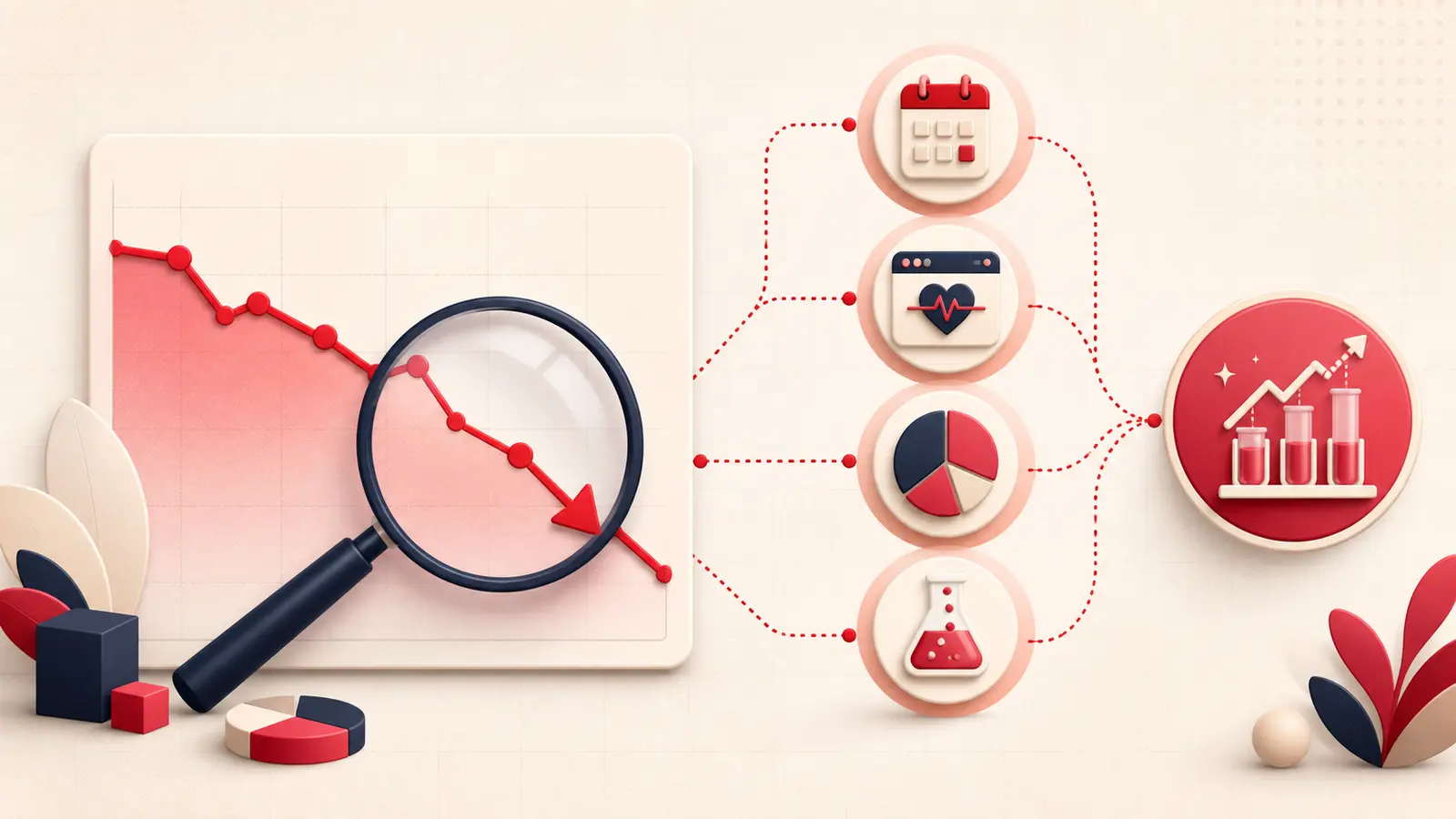
Verified August 31, 2026: Pinterest explicitly says performance can fluctuate with language, location, season, holidays, format, trends, and changing audience engagement. It does not publish a universal engagement window, and an old Pin can resurface months or years later.
Recent creator discussions describe sudden declines, including a May 2026 thread with several reports of sharp drops. Those accounts establish that creators are seeing the problem; they do not prove one platform-wide algorithm update or penalty. Diagnose the shape of your decline before changing the strategy.
Start with a comparable measurement
In Pinterest Analytics, compare periods that contain the same days of the week and similar seasonal conditions. Avoid comparing a seven-day holiday spike with an ordinary weekday or a partial current day with a completed day.
Pinterest's Analytics guide defines impressions as the number of times Pins or ads were on screen. Impressions are exposure, not unique people, clicks, or business results.
Confirm that the Analytics view did not change
- Check the date range and time zone.
- Separate organic and paid content.
- Check account, device, format, source, and claimed-domain filters.
- Note that Pinterest's Overview defaults to published content; use Include saved Pins only when that is the comparison you intend.
- If you recently converted to a business account or changed a claimed domain, document the change date.
A filter change can create a cliff in the chart even when distribution did not change.
Find the level where the decline begins
Account-wide decline
Check policy notices, publishing restrictions, domain problems, a major language or location mismatch, and whether most reach depended on one seasonal topic.
Several formerly dominant Pins declined
Your total may have been concentrated in a few Pins. Inspect their search terms, destination availability, seasonality, saves, and click trends separately.
Only new Pins are weak
Compare them with proven Pins on topic, originality, image clarity, title, board relevance, language, link destination, and mobile presentation. Do not conclude “shadowban” from a small sample.
Only one domain or page type declined
Test landing-page status, redirects, canonical URLs, robots rules, Pinterestbot access, page speed, and whether the Pin promise still matches the page.
Audit Pinterest's documented distribution checks
Pinterest's current performance and distribution guide recommends checking:
- Pinterestbot access and crawl delays;
- broken or incorrect destination links;
- Pin image, text, and keyword alignment with the landing page;
- website load time under four seconds;
- website claim status;
- original, high-quality vertical creative;
- regular publishing rather than bursts;
- duplicate uploads that could trigger spam controls;
- language, season, trend, and audience-interest fit.
This is a troubleshooting list, not proof that every listed factor is a direct ranking signal with a known weight.
Check for policy and security signals
- Review email plus the Reports and Violations Center.
- Confirm you can create and save a harmless test Pin.
- Check for suspicious-login or temporary rate-limit messages.
- Review recent connected sessions and third-party tools.
- Do not use automated posting behavior that violates Pinterest's rules.
A distribution decline without a notice is not evidence of a penalty. Keep “policy action,” “technical fault,” and “normal performance change” as separate hypotheses.
Use a seven-day diagnostic sheet
For each day, record:
Published Pins:
Impressions:
Saves and save rate:
Pin clicks and click rate:
Outbound clicks and rate:
Top three Pins:
Pages or domains affected:
Known seasonal/event context:
Site or policy incidents:
This turns “everything crashed” into a testable pattern.
Change one variable at a time
Test a small set of fresh creative for a topic and destination with existing relevance. Keep the page, publishing cadence, and audience language stable while changing one element, hook, visual hierarchy, or format. If you change ten things at once, recovery will teach you nothing.
Do not repeatedly upload near-identical Pins. Pinterest warns that duplicate creation can be treated as spam.
Escalate when evidence points to a fault
Contact Pinterest when publishing is blocked, Analytics is missing across comparable filters, claimed-domain data disappears, an enforcement notice appears, or the same technical fault persists across devices. Include dates, filters, example Pin URLs, affected domain, screenshots, and the troubleshooting already completed.
The recovery principle
Protect the system before chasing reach: working destination pages, crawl access, original creative, accurate metadata, and comparable Analytics. Then make controlled experiments. No outside expert can guarantee recovery or identify a secret algorithm update from one chart.
Keep building your Pinterest system
Continue with the guide that matches your next step:
Get the Notestopin Chrome extension
Add private notes to any Pin, tag them, and search your saves later.
Add to Chrome