Three months ago, you saved a bathroom.
It had warm tiles, a floating vanity, matte black hardware, and a mirror that felt just right. You remember thinking, “This is it.” You hit save. It went into your “Bathroom Renovation” board along with 247 other pins.
Today you open that board again.
You scroll.
And you have no idea why you saved half of it.
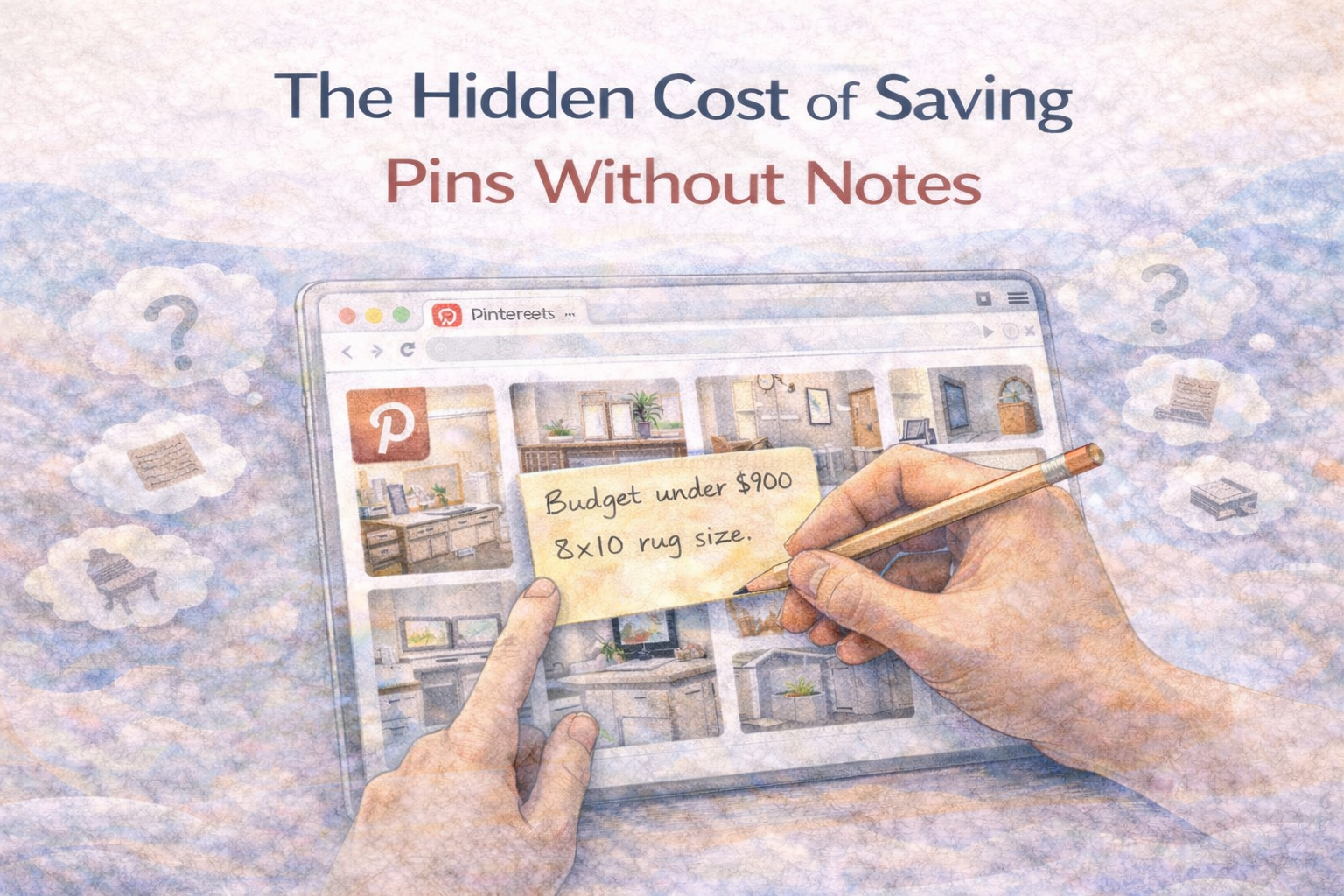
This is the hidden cost of saving Pinterest pins without notes. It is not clutter. It is lost thinking.
The Illusion of Productivity
Saving a pin feels productive. Your brain registers progress. You have captured something valuable. You are building a collection. You are planning.
But saving is not the same as deciding.
On Pinterest, it is easy to collect inspiration. It is harder to preserve intent.
When you saved that bathroom, you were not saving an image. You were saving a thought.
- Maybe you liked the grout color.
- Maybe the layout worked for a small space.
- Maybe the lighting temperature was perfect.
- Maybe it fit your budget.
The image remains. The reasoning fades.
Context Decay Is Real
Memory researchers have long observed that recall decays rapidly without reinforcement. Recognition lasts longer than reasoning. You can recognize the image. You cannot reliably recall the decision logic behind it.
Within days, nuance is gone.
Within weeks, your saved pin becomes just another bathroom.
Multiply that across hundreds of saved ideas. Now your boards are full of visual signals with no attached intelligence.
The Scroll of Confusion
Fast forward to the moment you actually need to make a decision.
You are ready to order tiles. You open Pinterest.
You scroll through dozens of options you once loved. Now every image demands re-evaluation.
You ask yourself:
- Was this saved for the vanity or the flooring?
- Was this within budget?
- Did I reject this one for a reason?
- Was this for the guest bathroom or the master?
You are thinking the same thoughts again.
This is the time tax of note-less saving.
The Hidden Cost: Cognitive Debt
Every unannotated pin carries future work.
You postponed clarity at the moment of saving. Now you must pay it back with interest.
If you have 400 pins in a board and spend just 15 seconds re-evaluating each one, that is 100 minutes of repeated thinking.
And that assumes you decide efficiently.
Often you hesitate. You open links again. You compare two similar options. You revisit pricing.
What looked like inspiration becomes friction.
Inspiration Is Broad. Execution Is Specific.
Pinterest excels at inspiration. It shows you what is possible.
But execution requires constraints.
Inspiration says “Modern kitchen.”
Execution says “24 inch cabinet depth, white oak finish, under $900 per unit.”
Inspiration says “Cozy living room.”
Execution says “No gray undertones. 8x10 rug minimum.”
Without notes, Pinterest remains in the inspiration phase.
A Real Example
Imagine you are planning a wedding.
You create boards for dresses, flowers, venues, table settings. You save aggressively. Everything feels aligned with your vision.
Six months later, you sit down with a budget spreadsheet.
You open your venue board. Half of the venues exceed your price range. You cannot remember which ones were realistic. You start researching again.
You are not starting from zero. But it feels like it.
If each venue pin had included a private note such as “Starts at $12,000, too high” or “Available in May, fits guest count,” your future self would thank you.
Instead, you pay with time.
Digital Hoarding vs Structured Thinking
Most Pinterest boards evolve into digital hoards. Beautiful hoards. Curated hoards. But hoards nonetheless.
Why?
Because saving is frictionless. Thinking is not.
Writing one sentence forces clarity. It requires you to articulate why something matters.
That is precisely why it works.
The Five Second Rule That Changes Everything
The fix is not complex.
When you save a pin, write one sentence explaining why.
Not “Nice.”
Not “Love this.”
Be specific:
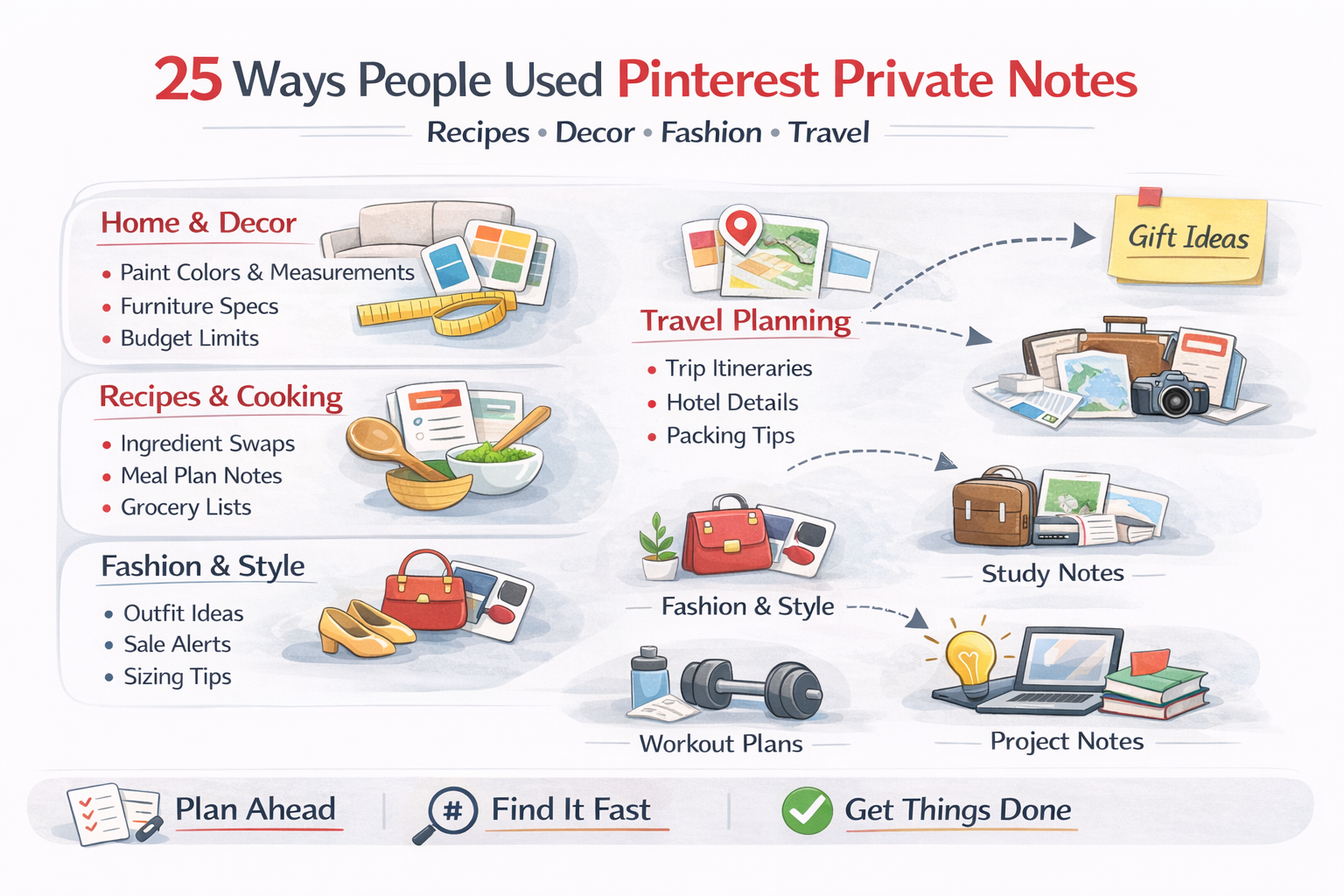
- “Like the brass handles, ignore cabinet color.”
- “Under $800 and ships fast.”
- “Swap cream cheese for dairy free.”
- “Use this layout for small bathroom version.”
This takes five seconds.
But those five seconds protect your original thinking from decay.
Why Boards Alone Are Not Enough
Many users try to solve Pinterest chaos by creating more boards.
Kitchen layout. Kitchen lighting. Kitchen storage. Kitchen budget.
This helps superficially. But real decisions are multi-dimensional.
A single sofa might belong to:
- #living-room
- #pet-friendly
- #under-1000
- #modern-style
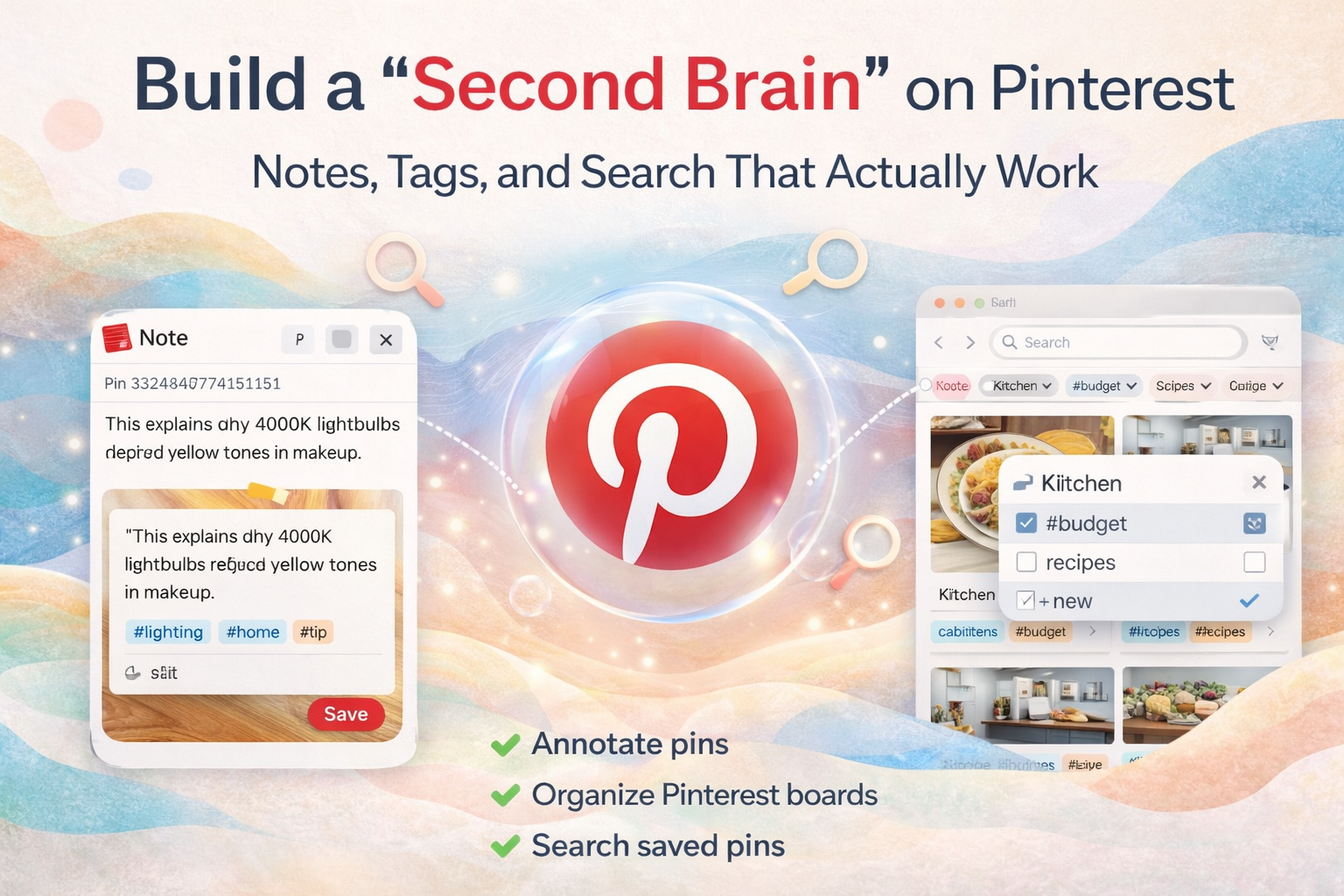
Boards force a single category. Tags allow layered meaning.
Combined with notes, they create retrieval power.
The Compound Effect Over Time
Imagine you save 1,000 pins over two years.
If half of them require even one minute of re-analysis later, that is 500 minutes. Over eight hours of repeated thinking.
Now consider projects that require heavy comparison. Renovations. Weddings. Product research. That hour becomes days.
The hidden cost is not visible at first. It accumulates quietly.
From Collector to Builder
There are two types of Pinterest users.
Collectors save images.
Builders capture decisions.
Collectors scroll and dream.
Builders annotate and execute.
The platform is the same. The behavior is different.
A Better Future Self
Picture opening your renovation board six months from now.
Each pin includes context:
- Why you liked it.
- Whether it fits the budget.
- Which room it belongs to.
- Whether it was rejected or shortlisted.
Instead of confusion, you feel clarity.
Your past thinking is preserved. Your decisions feel supported, not repeated.
The Real ROI of Notes
Adding notes is not about organization aesthetics. It is about leverage.
You are investing seconds now to avoid hours later.
You are transforming Pinterest from an inspiration feed into a decision archive.
The hidden cost of saving pins without notes is lost time, repeated thinking, and stalled projects.
The fix is simple but powerful.
Capture intent at the source.
Annotate when you save.
Let your future self inherit clarity instead of confusion.

Get the Notestopin Chrome extension
Add private notes to any Pin, tag them, and search your saves later.
Add to Chrome